
Simple Understanding of Insulation
Most Homeowners don’t really understand how important the insulation is needed to give you comfort and reduce those energy bills in your home. Below is some simple info on insulation.
How Insulation Works
You need insulation in your home to provide resistance to heat flow. The more heat flow resistance your insulation provides, the lower your heating and cooling costs.
Heat flows naturally from a warmer to a cooler space. In the winter, this heat flow moves directly from all heated living spaces to adjacent unheated garages, basements, and even to the outdoors. Heat flow can also move indirectly through interior floors, walls and ceilings wherever there is a difference in temperature. During the cooling season, heat flows from the outdoors to the interior of a house.
To maintain comfort, the heat lost in the winter must be replaced by your heating system and the heat gained in the summer must be removed by your cooling system. Properly insulating your home will decrease this heat flow by providing an effective resistance to the flow of heat.
Insulation’s resistance to heat flow is measured or rated in terms of its thermal resistance or R-value.
Here are the basic categories of Insulation
Loose Fill Insulation
Insulation that is made out of small chunks of fibers. It is also known as blown in insulation because it is blown in with a blower, a giant vacuum cleaner that works in reverse.
Batt Insulation
With batt insulation, insulative fibers are woven together to create a blanket of material. Batt insulation is available in 16 and 24 inch wide rolls usually in 8 ft. sections to fit standard spacing between the framing members in walls and ceiling joist. A paper or foil moisture barrier is installed on one side of this type of insulation which becomes the backing. The backing always is laid toward the inside of the house.
Rigid Insulation
Insulative fibers that are tightly sandwiched together between 2 layers of foil, creating a solid insulative material that looks a lot like plywood. Rigid Insulation is usually installed in between roof sheathing and roof covering when no attic exists.
Spray Foam
Spray Foam Insulation usually works in the most convoluted and irregular areas where normal insulation is hard to reach. Unfortunately this method usually only works if you have an open wall from remodeling or add on.
Different Insulation Material
Fiberglass Insulation
Fiberglass Insulation is the most popular and most widely available type of insulation. You can purchase it as either batt style or loose filled. It’s one of the least expensive and the batts are easily installed. Its not flammable and resist water damage.
Fiber glass batt is spun from molten glass and sand into fibers and is an extremely effective insulating material because tiny pockets of air resist the flow of heat and cold.
Fiber glass loose filled insulation is an extremely effective insulating material because its fibers prevent air movement and the resulting heat loss to resist the flow of heat and cold. It is designed for use in attics and hard-to-reach locations such as corners, nooks and crannies. It is installed dry, and because it will not settle over time, maintains its full R-Value over the life of the home.
Rock and Slag Wool
Rock and Slag wool batt is similar to fiber glass except that it is spun from slag and other rock-like materials instead of molten glass. It is sometimes called mineral wool. Mineral wool insulation was among the earliest commercial insulation types.
Rock wool (or slag wool) loose filled insulation is similar to fiberglass except that it is spun from blast furnace slag (the layer of impurities that forms on the surface of molten metal) and other rock-like materials instead of molten glass. The production of rock wool uses by-products that would otherwise be put in a landfill. Rock Wool insulation is well suited for locations where it is difficult to install other types of insulation, such as irregularly shaped areas, around obstructions (such as plumbing stacks), and in hard-to-reach places. Blown-in loose fill insulation are particularly useful for retrofit situations because, except for the holes that are sometimes drilled for installations, they are one of the few materials that can be installed without disturbing existing finishes. Rock wool is installed dry, and because it will not settle over time, maintains its full R-Value over the life of the home.
Cellulose
Cellulose is made from ground-up newspapers. It is treated with fire retardants, some of which have been known to cause corrosion of wiring and pipes. The product settles significantly over time and must be over-installed to compensate for this settling. All loose-fill insulation are required to detail their installed and settled thickness on the bag label to let consumers know the expected settled R-Value. Cellulose is applied using a mechanical blowing machine. In an attic, cellulose is not typically installed above an R-30 because its weight can cause sagging of the drywall. Most energy codes now call for R-30 to R-60 in attics.
Cotton/Denim
Made from cotton or recycled scrap denim there has been little independent testing done to look at the fire performance and moisture absorption of these products. Similar to cellulose insulation, these materials require the addition of fire retardant chemicals because they are combustible. Some fire retardants used in these products are know to cause corrosion of pipes and wiring.
The R-Value of Insulation
R-value indicates an insulation’s resistance to heat flow. The higher the R-value, the greater the insulating effectiveness.
The R-value depends on the type of insulation and includes its material, thickness, and density. When calculating the R-value of a multi layered installation, add the R-values of the individual layers. Installing more insulation in your home increases the R-value and the resistance to heat flow.
The effectiveness of an insulation’s resistance to heat flow also depends on how and where the insulation is installed. For example, insulation that is compressed will not provide its full rated R-value. The overall R-value of a wall or ceiling will be somewhat different from the R-value of the insulation itself because some heat flows around the insulation through the studs and joists. Therefore, it’s important to properly install your insulation to achieve the maximum R-value.
The amount of insulation or R-value you’ll need depends on your climate, type of heating and cooling system, and the section of the house you plan to insulate.
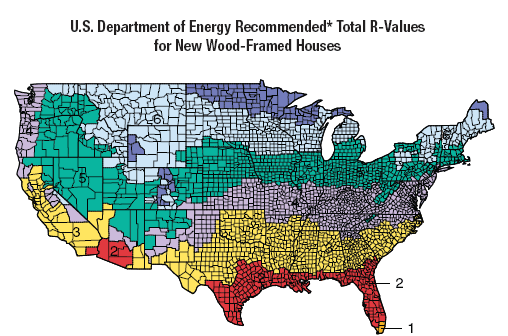
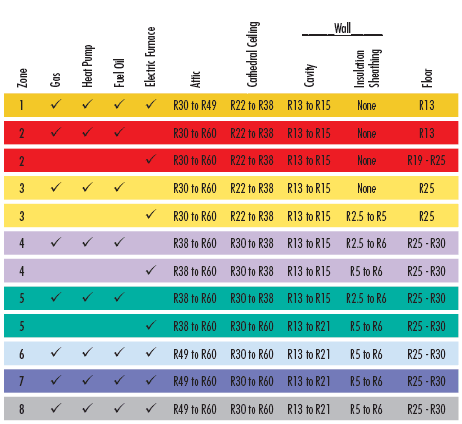
Before replacing or adding insulation to your attic you should determine whether or not you have moisture problems. Problems with moisture can become worse with adding insulation. Insulation can trap moisture causing mildew and mold to grow and spread. In addition, when water and moisture collect in the attic, it can cause stains and rot. Before putting in any insulation, it is best to seal all air leaks. This not only helps moisture, but also reduces heating bills by keeping cold air from entering the home. You may need to consider a radiant barrier.
Radiant Barrier
Radiant Barrier is nothing more than a light weight aluminum fabric that blankets the existing attic insulation. Radiant Barriers have hundreds of thousands of tiny holes that allow vapors to pass and prevent condensation from occuring at the ceiling level. These barriers also refelect heat from above during summer time, while at the same time holding on heat during the winter time. You install the barrier as a single sheet. Radiant barriers are not insulation, and by definition, have no R-value. However, there are some radiant barrier products that have entrapped air spaces (bubble pack or multilayer films) where an R-value may be available for the product. Testing has shown that it is more cost effective to add insulation than a radiant barrier.
Leahy’s Inspections, your Fort Worth Dallas Home Inspector provides quality inspections in Fort Worth, Arlington, Mansfield, Burleson, Joshua, Crowley, Everman, Rendon, Aledo, Benbrook, Cedar Hill, Grand Prairie, Midlothian, Dallas, Hurst, Euless and surrounding areas.
« Storing your Lawn Equipment for the Winter | Home | Deck Restoration »


Leave a Comment